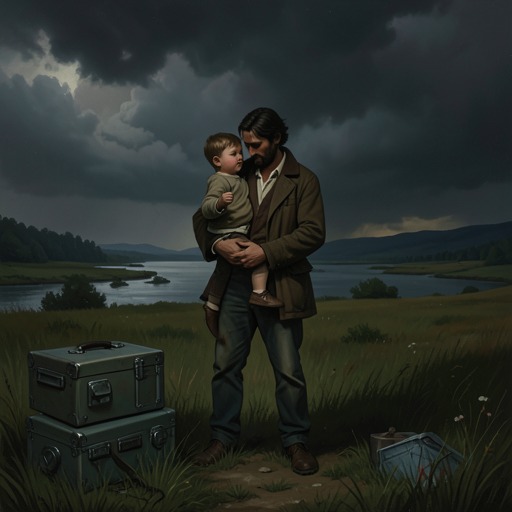
Tom’s recording
Bird BoxTom’s recording is a looped voice signal installed at the river approach to the Jane Tucker School for the Blind. It turns sound into both a warning and a welcome: the school uses it to tell a blindfolded arrival when to open her eyes, and its familiar voice was chosen to lead Malorie there. The recording’s practical purpose is inseparable from its emotional cost, because the voice that guides her also makes Tom’s absence unmistakable.
Design and Operation
Rick explains that the school cannot watch the river continuously because doing so would be too dangerous. Instead, a speaker near the water is activated by motion. It plays a clear recording for thirty minutes, looping the same forty-second sound bite loudly enough for someone on the river to hear. Rick presents the recording as a timed instruction: hearing it means the traveler has reached the point where she must open her eyes.
This system depends on sound carrying reliably across the river and through the woods. Malorie’s journey has already trained her to treat small splashes, birdsong, and echoes as information, while the children have learned to listen for life in the trees and along the banks. The recording adds a human-made signal to that uncertain soundscape: unlike the ambiguous noises of animals or a second set of oars, it is deliberate, repetitive, and tied to a specific action.
Tom’s Voice as a Guide
The choice of voice was intentional. Rick tells Malorie that the community decided Tom’s voice would alert her that she had arrived; if other travelers stopped at the fence first, the same recording could also let them know that some kind of civilization was nearby. Tom’s voice therefore serves two audiences: the person the school expected to reach the facility, and any stranger who might find the perimeter before reaching its entrance.
That arrangement assumes Tom is still with Malorie. When Rick asks whether the man on the recording is with her, she answers rigidly that he is dead. Rick explains that, had he known Tom was no longer there, he would have insisted on using something else, and apologizes. The recording has not merely misidentified the situation; it has made the school’s expectation audible before Malorie can enter and discover the people waiting there.
The Instruction and Its Cost
The message instructs Malorie to open her eyes, but she tells Rick that she cannot do it. At that moment, the recording’s practical clarity does not make the demanded act emotionally or physically possible for her. The voice can mark a threshold and tell her what the community expects; it cannot remove the danger that has governed her journey or compel her to accept the instruction.
Tom’s voice also carries the weight of earlier shared experience. In a separate moment, Malorie recalls Tom’s ideas as lingering in the house like ghosts, including his account of taking a walk with Jules to gather dogs and using them to find the way to Tom’s house. At the river, his recorded voice similarly turns a remembered companion into guidance for an action taken after his death. The recording’s significance lies in that tension: it offers a route toward other survivors, while confronting Malorie with the fact that the person whose voice marks the way cannot accompany her.